Enterprise DAST and Business Logic Testing: Why Most Scanners Miss What Attackers Actually Exploit

Enterprise DAST has earned its place in security programs and rightly so. It catches SQL (Structured Query Language) injection, cross site scripting, broken authentication, and the rest of the list of technical flaws without too much trouble.

But look at how real breaches happen and the picture changes. Most of the real damage does not come from a broken input field. It comes from application logic that was coded exactly right and got exploited anyway, simply because someone used it in a sequence nobody thought to test for.

That is the gap this article covers, the space between what Enterprise DAST catches and what attackers actually exploit. It remains one of application security’s harder blind spots to see. What follows explains why it exists, why it keeps widening, and how Bright STAR closes it.

What Enterprise DAST is designed to catch

Enterprise DAST works from the outside. Same angle an attacker takes. Send requests, watch what comes back, flag anything matching a known signature. Solid for a specific list: injection flaws, broken auth, insecure direct object references, exposed misconfigs. That kind of thing.

That layer remains essential. This is a limitation of the structure: DAST tests one request at a time. It sees patterns it has seen before. But it was never designed to follow a chain of legitimate actions and realize that together, they produce something the application was never intended to permit.

What business logic flaws actually are

A business logic vulnerability is a mismatch between the intended purpose of an application and the way it can be manipulated. No bad input, no payload, nothing that a signature match would pick up.

Every request looks normal on its own. The problem only shows up once someone maps out the intended workflow closely enough to see where it bends.

Take a checkout process. One endpoint validates the cart, a second applies a discount, a third handles payment. Test each in isolation and they all come back clean. But studying how the three connect, and calling payment directly, skipping the discount step, might let an order through at the wrong price. Nothing about that single request looks suspicious. The flaw is in the sequence, not any one piece of it.

The pattern repeats well beyond checkout: role checks that were not enforced tightly enough, coupon codes stacked or reused, race conditions that let a transaction process twice, approval steps skipped one at a time. None of it needs a technical exploit. It needs an understanding of intent, and that is exactly what pattern-matching was never built for.

Why enterprise DAST tools struggle here

Enterprise DAST platforms are built around a fairly straightforward assumption: that a vulnerability can be identified by examining a single request or response for known indicators of compromise. Business logic flaws simply do not fit that model, and the reasons why are worth unpacking.

It is not a vendor limitation, it is a structural one

This limitation is not specific to any particular vendor or product. It reflects a genuine structural difference between two categories of risk. Detecting a business logic flaw requires context: an understanding of what a sequence of actions is meant to accomplish, and the ability to recognize when that sequence has been manipulated to produce an outcome it was never meant to produce.

Technical vulnerabilities follow recognizable patterns

Technical vulnerabilities can usually be identified through signature matching, since the underlying flaw tends to look similar across many different applications. A scanner does not need to understand what a given application actually does. It only needs to recognize a pattern it has encountered before, somewhere else, in some other codebase.

Business logic vulnerabilities are application-specific

Business logic vulnerabilities work differently. They are, by their nature, specific to how an individual application was designed. There is no universal signature for something like “this checkout flow can be manipulated,” because the flaw depends entirely on how that particular application was built and how its individual components interact with each other.

The result is a familiar pattern across many enterprise security programs: strong coverage against a well-understood category of technical risk, paired with a much weaker ability to detect the category of risk that experienced attackers increasingly go after, precisely because it slips past automated pattern matching.

Why this gap matters more today

Today’s applications are far more interconnected than they were just a few years ago. Behind the scenes, it’s common for a single client activity, such as completing a purchase or submitting a claim, to start a chain of calls through multiple APIs and microservices. Every step in that process is another opportunity for manipulation of business logic.

The broader push toward API driven architecture has expanded the attack surface dramatically. Development velocity tells a similar story. Features that once took months to ship now go out in a matter of weeks, and AI assistance is accelerating that timeline further in many organizations.

Enterprise DAST scans still catch technical vulnerabilities in this new code reasonably well, but the business logic implications of a new workflow are rarely something an automated scan can surface on its own. An application can pass a technical security scan with a clean report and still contain a business logic flaw capable of significant financial or data exposure.

How Bright STAR approaches business logic testing

Bright STAR, Bright Security’s platform for security testing and automated remediation, was built with this specific gap in mind. Instead of viewing each request as a stand-alone event, Bright STAR considers application workflows in context. It checks whether not only one endpoint is vulnerable, but whether the larger set of actions available to a user can be manipulated to achieve a result the application was never intended to allow.

Bright STAR’s context-aware approach reveals issues that typical Enterprise DAST tools miss, such as workflow bypass, incorrect ordering of multi-step processes, and manipulation of business rules based on the order or combination of actions taken. Unlike pattern matching, Bright STAR validates exploitability in a real runtime environment, which means Bright STAR‘s findings are proof, not inference. This keeps false positives below 3%, even when evaluating complex, multi-step scenarios.

The platform extends that same validation into the remediation process as well. When a business logic vulnerability gets confirmed, Bright STAR doesn’t just hand over a generic description and leave engineering teams to piece together the attack path themselves. It provides the specific exploit context needed to actually understand and fix the issue. That matters most here, because a real fix depends on knowing not just what broke, but why that particular sequence of actions caused it in the first place.

What this means for enterprise security programs

Enterprise DAST remains an essential layer of any application security program, and organizations should continue relying on it for the technical vulnerability categories it was built to catch. The mistake lies in assuming that strong DAST coverage amounts to comprehensive protection against the vulnerabilities attackers are actually most likely to exploit.

A more complete approach tends to rest on a few practices:

  • Treat business logic testing as its own requirement, rather than something bundled into technical scanning as an afterthought.
  • Evaluate whether security tooling genuinely understands workflow relationships, rather than simply assessing each request on its own.
  • Prioritize platforms that validate exploitability directly, since business logic flaws are particularly prone to producing false positives or false negatives when assessed through pattern matching alone.

Application architectures are only becoming more complex and interconnected, and attackers are becoming more sophisticated in how they specifically target business logic. Organizations addressing this gap today are likely to be in a more grounded position going forward.

Frequently asked questions

How do technical flaws differ from business logic flaws?

A technical vulnerability, SQL injection being a good example, usually involves malformed input or a payload a scanner can spot. A business logic vulnerability looks nothing like that. It involves legitimate, properly formed requests, just used in a sequence the application was never built to allow. Neither the input nor the individual request raises any flags, which is exactly why automated tools struggle to catch it.

Can Enterprise DAST tools detect business logic flaws?

Not typically. DAST tools make individual requests and therefore cannot see how different steps of a workflow relate to each other. Spotting these flaws requires context-aware testing that recognizes when a legitimate workflow has been manipulated to produce an unintended outcome.

Why do business logic vulnerabilities often go unreported by automated scanners?

Scanners are built to flag known attack signatures, and business logic flaws simply don’t have one. Each depends entirely on how a specific application was designed. Without a way to evaluate multi-step processes in context, a scanner has nothing to compare against and no basis for flagging the issue.

How does Bright STAR identify business logic vulnerabilities that other tools miss?

Bright STAR looks at application workflows as a whole rather than testing requests one by one, and confirms exploitability directly inside a live environment. That approach surfaces things like workflow bypass and improper sequencing, issues that only show up once you understand how several steps interact, while keeping false positives below 3%.

Should organizations replace Enterprise DAST with business logic testing?

No, replacing one with the other isn’t prudent. The two address different categories of risk, and both stay essential for truly comprehensive coverage. They are most effective when used together, not as a substitute for one another.

Bottom line

Enterprise DAST is not the problem, it was never designed to detect business logic flaws. It performs its job and performs it well. Business logic vulnerabilities essentially sit outside that scope, in a place signature matching was never built to reach. Closing that gap takes a distinct kind of testing, one that understands how a workflow is meant to act and can recognize the moment it is bent out of shape. That’s the layer Bright STAR was built to add, not in place of Enterprise DAST, but alongside it.

AI Security for Regulated Industries Without Higher Costs

Regulated enterprises do not need a separate security stack for every AI application. They need better control over the systems they already run.

That distinction matters. When security, compliance, privacy, and engineering teams build separate review processes, AI security becomes expensive before it becomes effective. The same access control gets assessed several times. Developers receive overlapping findings. Audit evidence sits across scanners, tickets, spreadsheets, and email threads.

The better approach is to reuse common controls, keep AI applications inside existing DevSecOps workflows, test the complete system at runtime, and record evidence as the work happens. This does not remove the need for model governance, privacy review, or human oversight. It prevents those functions from becoming a second, disconnected security program.

The cost of weak oversight is already visible. IBM’s 2025 research found that 63% of breached organizations lacked an AI governance policy or were still developing one. One in five reported a breach linked to shadow AI.

Why AI security costs multiply

AI systems rarely operate alone. A customer assistant may connect to a model, a retrieval database, internal APIs, payment services, customer records, cloud roles, and third-party tools.

Every connection creates another place where controls can fail. Prompts can manipulate behavior. APIs can expose data through broken authorization. Agents can receive more permissions than they need. Model output can reach downstream systems without adequate validation.

The cost problem starts when each team reviews these risks separately. Privacy examines data use. Model risk evaluates outputs. AppSec tests the application. Cloud teams inspect infrastructure. Internal audit asks for proof. Developers receive the combined work at the end.

This fragmented structure creates duplicate assessments and conflicting priorities. Security findings arrive through separate tools with different severity models. Compliance teams request evidence that engineering has already supplied elsewhere. Developers spend time confirming whether reported issues can affect the deployed system.

The lesson is not that every enterprise needs more products. Fragmented ownership and late discovery are the expensive parts.

AI security costs rise when teams duplicate controls, collect evidence manually, and send unvalidated findings into engineering queues.

What does AI security compliance actually require?

AI security compliance requires organizations to identify AI systems, classify risk, control access, protect sensitive data, test deployed behavior, monitor activity, manage incidents, and retain evidence that issues were fixed. Frameworks use different language, but many depend on the same operational controls. Build those controls once, then map them to each obligation.

The NIST AI Risk Management Framework supports voluntary AI risk management across design, development, deployment, use, and evaluation. Its Generative AI Profile adds actions for risks that are more specific to generative systems.

The EU AI Act implementation timeline adds legal duties based on system risk. Following the 2026 AI Omnibus, rules for Annex III high-risk systems apply from December 2, 2027, while rules for high-risk AI embedded in regulated products apply from August 2, 2028.

Industry, privacy, operational resilience, and management-system requirements may add further obligations based on the organization’s location, data, customers, and use case.

No security tool makes an organization compliant. Tools support controls and produce evidence. Accountability stays with the organization.

Reuse controls instead of rebuilding them

Different frameworks often ask for the same underlying work. The names change. The operational control does not.

Common requirementShared controlReusable evidence
Identify AI-related riskMaintain an inventory of AI applications, models, APIs, data sources, and integrationsArchitecture records, system inventory, data-flow diagrams
Restrict accessApply role-based access, least privilege, authentication, and secrets managementAccess reviews, identity logs, configuration records
Protect dataLimit data collection, secure storage and transmission, and validate outputsData classification, encryption evidence, test results
Test securityTest applications, APIs, workflows, and AI-specific attack pathsScan history, validated findings, penetration-test records
Manage vulnerabilitiesAssign owners, remediate issues, and verify fixesTickets, remediation notes, retest results
Demonstrate oversightRecord approvals, exceptions, monitoring, and human reviewRisk assessments, audit logs, exception records

A shared control library gives each control one definition, owner, testing method, and source of evidence. Compliance teams can then map that control to several requirements without asking engineering to repeat the same work.

This only works when the evidence is specific. “DAST is enabled” is not evidence that a relevant application was tested. A useful record shows the target, environment, authentication state, coverage, finding, owner, remediation status, and retest result.

Control reuse reduces audit work because it replaces repeated claims with consistent technical proof.

Keep AI applications inside DevSecOps

An AI-powered application is still an application. It contains code, APIs, identities, cloud resources, open-source dependencies, databases, and business logic.

Those components remain exposed to familiar weaknesses such as injection, broken access control, server-side request forgery, insecure API design, and configuration errors. AI-specific testing does not replace SAST for code, SCA for dependencies, or DAST for the running application. Each method answers a different question.

Do not create a separate delivery process for AI features. Add them to the existing application inventory and apply security checks during pull requests, builds, staging deployments, and release cycles.

The workflow should be practical:

  1. Identify the application, model, data sources, APIs, and actions available to the system.
  2. Apply code, dependency, identity, cloud, and runtime tests at the appropriate stage.
  3. Send confirmed findings into the ticketing system developers already use.
  4. Set release gates according to exploitability and business impact.
  5. Retest after remediation rather than relying on a closed ticket.

This keeps AI security close to the code and the people who can fix it. It also reduces the cost of late-stage reviews, where every finding competes with release deadlines.

Test the complete runtime system

Model evaluation can show whether a model produces unsafe or inaccurate output under defined conditions. Code analysis can identify weaknesses in source code. Neither shows the full behavior of a deployed application.

Consider an assistant that retrieves customer records and submits account changes. The model may pass a safety evaluation. The surrounding code may pass static analysis. The deployed workflow could still expose another user’s data, pass unsafe model output into an interpreter, or let a manipulated prompt trigger an excessive action.

The OWASP Top 10 for LLM Applications identifies risks including prompt injection, sensitive information disclosure, improper output handling, excessive agency, and vector or embedding weaknesses. These issues often emerge through interactions among the model, application, API, identity layer, and connected tools.

Runtime testing examines what the deployed system actually accepts, accesses, returns, and changes. It also finds conventional application and API vulnerabilities around the AI feature.

This is the gap many compliance programs miss. A model can behave as designed while the application around it remains exploitable.

Validate findings before they enter the backlog

Security scanners often report possibilities. Developers then spend time deciding whether each issue is reachable, reproducible, or exploitable.

That investigation is a real operating cost. Large backlogs hide urgent issues among low-value tickets. Repeated false alarms weaken trust. Teams start treating security gates as administrative work rather than risk controls.

Runtime validation changes the sequence. It tests whether a suspected weakness affects a running application before the finding becomes another engineering task.

A validated finding gives developers evidence they can reproduce. Security teams can prioritize confirmed exposure. Compliance teams gain a clearer record of what was found, why it mattered, and how it was addressed.

This does not mean every issue must be exploited before teams act. Some design flaws, dependency risks, or control failures require action based on credible exposure and business context. The point is to use the strongest available evidence instead of treating every scanner output as equal.

Runtime validation for AI penetration testing helps reduce noise where dynamic confirmation is possible. Detection provides scale. Validation provides confidence.

Automate evidence and verify every fix

Audit preparation becomes expensive when teams assemble screenshots, scan reports, tickets, approvals, and email threads after the work is finished.

Security testing should create evidence during the workflow. For each relevant test, retain:

  • The application and version tested
  • The environment and test configuration
  • Authentication and coverage details
  • The affected component and evidence of exploitability
  • The assigned owner and remediation status
  • Any approved exception
  • The retest result

This evidence supports more than an audit. It helps AppSec teams compare coverage, identify recurring weaknesses, and prove whether remediation changed the application’s behavior.

Fix verification matters because workflow status is not technical proof. A developer can close a ticket while the vulnerable path remains reachable. A configuration can drift after an approved change. A later release can reintroduce the same issue.

Automated retesting closes that gap. It confirms whether the original behavior still exists and records the result without creating a separate evidence-collection project.

The practical target is continuous assurance, not continuous paperwork.

Where runtime application testing fits

AI compliance includes model governance, data lineage, privacy assessments, human oversight, vendor management, legal classification, and business-risk decisions. Application security covers only part of that scope.

Bright Security supports the application and runtime layer. Bright STAR is designed to find, remediate, and validate vulnerabilities across human-written and AI-generated code within development workflows. Bright DAST tests running applications, APIs, business logic, and LLM-connected software from an attacker-like perspective.

That position matters because compliance teams often have policy evidence but limited proof of deployed behavior. Dynamic testing can show what was tested, whether a weakness was exploitable, and whether the fix changed the result.

The platform can also connect testing to CI/CD, which lets teams test more frequently without turning every assessment into a manual project. The Pacífico Seguros case study reports that automated DAST in CI/CD reduced average time to market from 45 days to 25 days while supporting security and compliance work.

The customer described security as “an integral accelerator of releases and company innovation.”

That is useful evidence of workflow improvement. It is not a claim that one platform covers every AI risk or makes an enterprise compliant.

Frequently asked questions

What is AI security?

AI security protects models, applications, data, APIs, identities, infrastructure, and automated actions from manipulation, unauthorized access, data exposure, misuse, and exploitable vulnerabilities. It includes AI-specific risks such as prompt injection and excessive agency, along with conventional software and API weaknesses.

Why is AI security harder in regulated industries?

Regulated organizations must protect sensitive data and prove that controls operate as intended. AI systems also connect models to applications, APIs, databases, and automated actions. That combination increases technical risk while creating more evidence, oversight, and accountability requirements.

Can existing AppSec tools secure AI applications?

Existing tools remain necessary because AI applications still contain code, dependencies, APIs, cloud services, and identities. They are not sufficient on their own. Teams also need model evaluation, data controls, runtime testing, monitoring, and human review based on the system’s use and risk.

How can enterprises reduce AI security costs?

Reuse shared controls across frameworks, keep AI systems inside existing DevSecOps workflows, prioritize validated risk, automate evidence collection, and verify fixes. The goal is not fewer controls. It is less duplication, less manual investigation, and stronger proof that the controls work.

Do not build a second security program

The expensive approach to AI security is easy to recognize. Every framework gets its own checklist. Every team buys another tool. Every audit triggers a new evidence hunt. Developers receive more findings but little help deciding what matters.

Regulated enterprises should resist that model.

Build a common control library. Apply it to AI systems through the workflows engineering already uses. Test deployed behavior, not only policies, models, or source code. Validate findings where possible. Retest fixes. Keep evidence attached to the work.

This will not remove every manual review. It should not. Model governance, privacy, legal classification, and high-impact business decisions still require accountable people.

The objective is narrower and more useful: stop paying several teams to prove the same control in different ways. A well-designed AI security program gives compliance better evidence, developers a smaller and more credible backlog, and security leaders a clearer view of real application risk.

See how Bright Security helps enterprises validate application risk, reduce remediation effort, and secure the AI-driven SDLC.

Enhancing DAST for FHIR: Optimizing Security Testing in Healthcare APIs

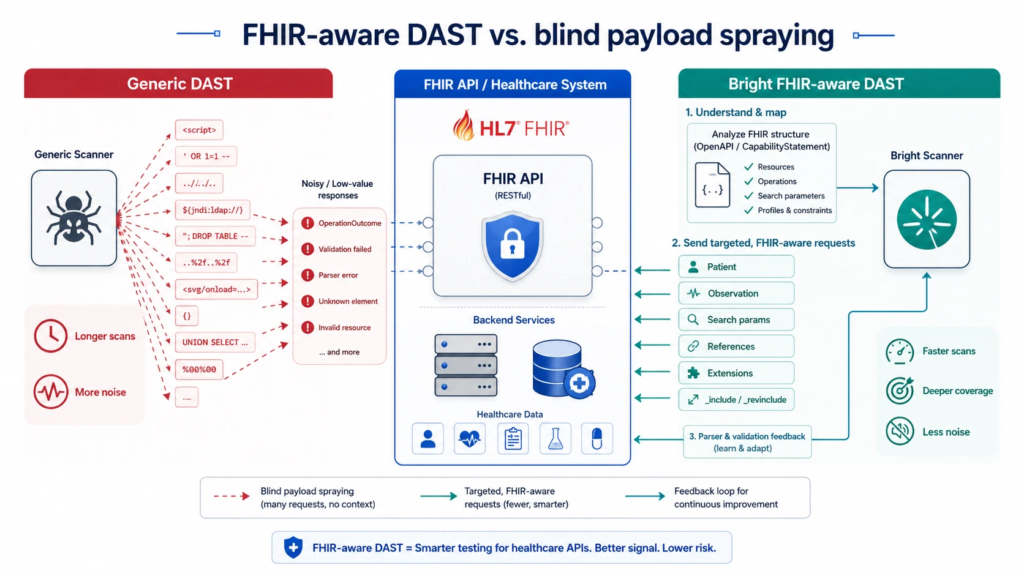
Traditional DAST scanners are effective when they understand the application surface they’re testing. That works well for common web patterns like REST APIs, GraphQL, gRPC, forms, JSON bodies, and standard authentication flows. But plenty of business-critical applications run on industry-specific data exchange protocols that generic scanners simply don’t understand deeply. When that happens, DAST tends to fall back on blind payload spraying: firing large volumes of generic payloads at every visible field, with no real sense of which inputs matter, which fields are structurally constrained, and which parts of the request can actually influence backend behavior.

Table Of Contents

  1. Where Generic DAST Breaks Down on FHIR
  2. Why This Is a Bigger Problem Than It Looks
  3. How Bright Built FHIR-Aware DAST
  4. The Result: Faster Scans, Deeper Coverage, Less Noise

Where Generic DAST Breaks Down on FHIR

The generic approach is failing to function in a clear example such as the HL7 standard for healthcare information exchange: FHIR. At a first glance FHIR APIs are like any other RESTful web APIs; they have HTTP RESTful endpoints that return JSON or XML. In reality, they adopt a rich healthcare-specific data model based on entities such as Patient, Observation, Encounter and Practitioner, just to mention a few. These resources contain many nested objects, references, coded values, extensions, profiles, and strict validation rules.

A scanner that treats FHIR as if it were plain old JSON is not going to get any of that context in the protocol and will waste time on inputs that were never going to be useful in coverage anyway.

The scale of the problem is what makes it painful. There can be a tremendous parameter space exposed by FHIR APIs, with resource fields, search parameters, chained parameters, and profile-specific constraints. Many of those inputs are strongly typed or constrained by resource schemas, value sets, date and quantity syntax, or implementation-specific profiles. Blind fuzzing of inputs like these mostly produces predictable validation failures and rejected requests, not meaningful security signal. The scanner looks busy. The coverage doesn’t actually improve.

Why This Is a Bigger Problem Than It Looks

This isn’t a theoretical gap. Independent research into FHIR implementations has repeatedly found that the risk sits less in the FHIR standard itself and more in how it gets implemented, especially at the API layer where aggregators, mobile apps, and third-party integrations connect to EHR systems. One widely cited study of production FHIR APIs found that every API tested allowed a single patient’s login to pull other patients’ health data, and that the majority of the mobile apps tested shipped with hardcoded API keys and tokens attackers could lift directly.

More recent analyses point in the same direction: broken object-level authorization, overly broad token scopes, and inadequate input validation keep showing up as the recurring weak points in FHIR and REST healthcare APIs, alongside documented issues like XXE injection in authentication flows. None of that is a flaw in FHIR as a specification. It’s a reflection of how much surface area FHIR’s flexibility creates, and how easy it is for a generic testing approach to miss the parts of that surface that actually matter.

For healthcare organizations, the stakes are higher than a typical web app. A missed authorization flaw doesn’t just expose a record, it exposes protected health information across potentially millions of patients, with HIPAA and GDPR exposure attached. That’s exactly the kind of risk that gets buried under noise when a scanner spends its cycles on low-value fuzzing instead of the resources, search paths, and references where real vulnerabilities tend to hide.

How Bright Built FHIR-Aware DAST

At Bright, we made an extension to FHIR support to enable our enterprise level DAST engine to detect and deal with these protocol-specific constraints rather than work around them blindly. The analyzer knows when the input is structurally valid, when it’s likely to contain low value data, and when the behaviour of the backend parser or validation will prevent injection to take place.

Instead of spraying payloads into any field it can locate, Bright optimizes test generation directly on the FHIR data model and direct on the parts of the request that are likely to reveal any security-relevant behavior. An integral part of this is the way this response is handled in the backend, as the parser / validation result is used as feedback to the engine to learn how to behave and what to test next, and not always perform the same scan pattern for all resources / endpoints.

In practice, that means Bright’s scanner can tell the difference between a rigid, schema-locked field that’s not worth fuzzing and a resource, chained search parameter, or reference that’s actually worth probing for injection, authorization, or logic flaws, the same categories of issues that keep showing up in real-world FHIR incident research.

The Result: Faster Scans, Deeper Coverage, Less Noise

The payoff is a scan that’s both faster and deeper. By avoiding low-value fuzzing of rigid FHIR inputs, Bright can significantly cut scan duration in FHIR-heavy applications while preserving, and sharpening, coverage of the high-value resources, search paths, and references that matter most.

For healthcare organizations processing and exchanging sensitive patient data, that precision isn’t a nice-to-have. FHIR-aware DAST lets healthcare teams test their APIs with more accuracy, less noise, and a testing approach that actually matches how clinical data exchange systems behave in production, not how a generic web scanner assumes they behave.

Blind spraying was never a security strategy; it was a workaround for not understanding the protocol. Once a scanner understands FHIR the way it understands REST or GraphQL, testing healthcare APIs stops being a trade-off between speed and depth.

AI Penetration Testing Works, But Findings Need Runtime Validation

Table Of Contents

  1. Introduction – The AI Pentesting Boom Is Real
  2. Why AI Penetration Testing Has Become Essential
  3. What AI Pentesting Does Exceptionally Well
  4. The Gap: Findings Are Not the Same as Verified Risk
  5. The Hidden Cost of Acting on Noise
  6. Runtime Exploit Validation – What Actually Closes the Gap
  7. From Finding to Verified, Fixable Result
  8. How Bright STAR Makes AI Pentesting Enterprise-Ready
  9. FAQ
  10. Conclusion – Adopt AI Pentesting, But Validate Everything

Introduction – The AI Pentesting Boom Is Real

It was just a matter of time before the concept of an independent AI agent identifying vulnerabilities like an experienced pentester appeared to be impossible. This notion is no longer out of reach today.

AI-based security solutions are mapping out attacks, studying application behavior, and even participating in public bug bounties. An experimental attempt has become a reality very quickly and has entered the world of enterprise security. Those who doubted that AI technology could make any meaningful contribution to pentesting are now considering which platform to pick up.

Traditional methods cannot cope with the speed of today’s applications. Teams are deploying dozens of times a day, APIs are changing at all times, and vulnerabilities are used as weapons as soon as they are discovered. There’s just no way for security teams to keep up using only annual pen-tests and assessments.

AI-powered penetration testing addresses a problem that exists in reality.

It increases coverage, provides more flexibility, and allows companies to find threats faster than with traditional solutions.

But there is one thing that many companies realize when they implement the solution.

Finding a vulnerability does not always mean exploiting it.

This distinction becomes one of the most important discussions in modern application security.

And the companies that manage to make the most out of AI pentesting are doing that by complementing the process with the classic exploitation validation.

Why AI Penetration Testing Has Become Essential

Security teams for applications are encountering a scaling issue.

Today’s enterprises have hundreds to thousands of applications, APIs, microservices, and cloud-native services under their management. Each release cycle introduces some new functionalities and dependencies. Potentially, there are some new attack surfaces.

Penetration testing remains highly relevant, but it is not meant to cope with rapidly changing environments.

Penetration testing with AI solves this issue by providing automated discovery and analysis capabilities. Rather than relying on scheduled penetration tests, organizations can test their applications all the time when they are being developed and improved.

The reason is that hackers don’t wait for quarterly assessments.

Upon the publication of any vulnerability, threat actors start scanning for vulnerable targets right away. Security teams require testing capabilities that allow doing the same thing.

AI penetration testing tools do so by performing continuous application analysis and revealing the possible attack vectors faster than any manual techniques would do.

What AI Pentesting Does Exceptionally Well

AI pentesting brings several advantages that security teams should absolutely embrace.

First, it dramatically improves coverage. An AI agent can evaluate far more applications, APIs, and endpoints than a human tester can realistically assess within the same timeframe.

Second, it excels at identifying patterns across large environments. Security issues that may appear unrelated when viewed individually often become obvious when analyzed at scale.

Third, AI enables continuous testing. Traditional pentests provide a snapshot in time. AI-powered assessments can run continuously as applications change.

These capabilities make AI pentesting an important evolution in AppSec. The challenge isn’t whether AI should be used. The challenge is whether organizations can trust every finding it produces.

The Gap: Findings Are Not the Same as Verified Risk

This is where many security programs encounter friction.

AI systems are extremely good at identifying patterns that suggest vulnerabilities may exist. They’re far less reliable when determining whether those vulnerabilities can actually be exploited in a real-world environment.

A finding may look convincing in a report. It may even include a detailed explanation of the attack path.

That doesn’t necessarily mean an attacker can exploit it.

The reason is simple. Most AI systems optimize for probability and reasoning. They generate conclusions based on patterns and likelihoods.

Applications don’t operate on probability. Applications operate on runtime behavior.

A vulnerability may appear reachable during static analysis but be blocked by runtime controls. An exploit path may seem valid but fail because of application logic. Authentication mechanisms, access controls, business workflows, and environmental factors can all influence whether a vulnerability is truly exploitable.

This is one reason false positive rates remain a major concern across many AI-driven security tools.

Without a validation layer, organizations often find themselves investigating findings that never represented real risk in the first place.

The Hidden Cost of Acting on Noise

False positives create more damage than most security metrics reveal.

Every questionable finding generates work.

Security analysts review reports. Developers investigate code. Engineering teams create tickets. Meetings are scheduled to determine priority.

Then someone eventually discovers the issue wasn’t exploitable. That process may consume hours or days of effort for a single finding.

Now multiply that across hundreds of applications and thousands of findings. The operational cost becomes significant. Beyond wasted effort, excessive noise creates a second problem: trust.

When developers repeatedly encounter findings that cannot be reproduced, confidence in security tooling begins to decline. Security teams spend more time defending findings than reducing risk.

The result is slower remediation, larger backlogs, and reduced security effectiveness.

Runtime Exploit Validation – What Actually Closes the Gap

This is where runtime exploit validation changes the equation.

Rather than assuming a vulnerability exists because an AI model believes it does, runtime validation proves whether exploitation is actually possible.

Think of it as grounding AI analysis in real-world application behavior.

Instead of stopping at discovery, the validation process actively tests exploitability within the running application environment. It confirms reachability, verifies execution paths, and eliminates findings that cannot be reproduced under real conditions.

This dramatically changes the quality of security results. A validated finding is no longer a theory. It becomes evidence.

Organizations that implement a combination of artificial intelligence penetration testing and run-time exploit verification tend to have much lower rates of false positives compared to organizations using only artificial intelligence-derived results. Furthermore, security professionals are assured of the business value of any vulnerabilities that they focus on.

That is the difference between alerting and creating security results.

From Finding to Verified, Fixable Result

The most effective AppSec programs don’t stop at detection.

They follow a complete workflow. AI discovers a potential vulnerability. Runtime testing validates exploitability. Remediation guidance helps developers fix the issue. Validation confirms the fix works.

This creates a closed-loop security process that focuses engineering effort where it matters most.

For modern development teams, that’s far more valuable than another list of theoretical risks.

How Bright STAR Makes AI Pentesting Enterprise-Ready

Bright STAR was designed around a simple observation: enterprises don’t need more findings. They need more confidence.

Most organizations already have security tools capable of generating alerts. The challenge is determining which findings are real, which deserve immediate attention, and whether remediation efforts actually work.

Bright STAR combines AI-powered analysis with Bright’s deterministic runtime testing engine to solve this problem.

Instead of relying solely on AI-generated conclusions, STAR continuously validates findings against real application behavior. This helps eliminate noise and ensures security teams focus on vulnerabilities that can genuinely be exploited.

The platform goes beyond discovery.

Bright STAR helps organizations identify vulnerabilities, generate remediation guidance, validate fixes, and maintain evidence that supports compliance initiatives.

The result is a dramatically different security workflow.

Instead of spending weeks investigating findings and coordinating remediation efforts, teams can move from discovery to validated remediation in minutes.

For enterprises managing large application portfolios, that translates into faster remediation cycles, stronger security outcomes, and significantly greater confidence in the results.

Because ultimately, the goal isn’t finding vulnerabilities.

The goal is to reduce risk.

FAQ

Is AI penetration testing accurate enough to base conclusions on?

Yes, but the accuracy highly depends on validation. AI is tremendously efficient at detecting possible attack vectors and security holes. However, companies must validate their discoveries during runtime testing to understand the extent to which these vulnerabilities can be exploited.

What is runtime exploit validation, and why is it important?

Runtime exploit validation helps determine whether the vulnerability can be used to exploit a live application. It reduces the number of false positive discoveries and helps focus on real threats.

How to reduce false positives when using AI for security?

The best way is to combine AI-based discovery with deterministic runtime exploit validation, which will help companies confirm their exploitability instead of just trusting AI.

Can AI pentesting substitute manual penetration testing in enterprises?

AI pentesting definitely substitutes traditional methods of penetration testing as it increases coverage and frequency. However, there are areas where only manual penetration testing is helpful, such as business logic assessment and others.

Conclusion – Adopt AI Pentesting, But Validate Everything

AI penetration testing is not a passing trend.

It’s becoming a core component of modern application security programs because it solves a real problem: scale.

Organizations can test more applications, identify more risks, and respond faster than ever before.

But discovery alone is not enough.

The difference between a useful finding and an expensive distraction is validation.

Enterprises that pair AI pentesting with runtime exploit validation gain something far more valuable than additional alerts: confidence.

Confidence that findings represent real risk. Confidence that remediation efforts are working. And confidence that security investments are producing measurable results. The future of application security isn’t AI alone. It’s AI backed by proof.

Securing the Company Wallet: How Automated Validation Reduces AppSec Costs

Table Of Contents

  1. Why Application Security Is Becoming More Expensive
  2. The Hidden Cost of Security Findings
  3. Why Traditional Security Testing Creates Waste
  4. How Automated Security Validation Helps
  5. Protecting Your Budget with Bright STAR
  6. Conclusion

Why Application Security Is Becoming More Expensive

Application security has become more crucial than ever before. At the same time, application security has become costlier than ever before.

In today’s world, companies are developing more applications, rolling out more updates, and even incorporating AI-based coding assistants to develop their applications faster. Though all of these things contribute to increased efficiency, at the same time, they create chances of vulnerabilities getting into applications.

It is not about identifying security issues alone, as the security department has enough technology to do so. It is about knowing which one is an actual vulnerability that requires urgent action.

Every unnecessary investigation consumes engineering time, security resources, and ultimately money. That’s why many organizations are beginning to view application security as both a security challenge and a business challenge.

The Hidden Cost of Security Findings

Security findings are not free.

Each such vulnerability found by the scanner always starts a process.

First, security professionals analyze the finding, then developers look into what’s wrong in the code. Teams will determine priorities for fixing and perform extra tests before release.

But when such a finding is false, redundant, or exploitable, that effort becomes wasted.

The most underreported and expensive cost in application security is definitely that of false positives. The development team will be wasting its time investigating alerts that did not pose any actual risk to start with. Meanwhile, the security team spends its efforts on triage rather than mitigating the risks.

This all leads to security debt, remediation backlog, and a lack of trust in security tools among developers.c

Vulnerabilities That Worsen Application Security

There are certain vulnerabilities that take more resources to manage than others.

SQL Injection

SQL injection is arguably among the worst vulnerabilities found in applications in terms of damage. This type of vulnerability could lead to the exposure of the most sensitive databases, user details, and business-related details.

The work required by security professionals to validate the possibility of exploiting user input in databases has been substantial.

Cross-Site Scripting (XSS)

XSS vulnerabilities remain prevalent in today’s modern applications despite all the security recommendations.

Application development requires dealing with vast amounts of user-generated content, meaning that multiple XSS vulnerabilities should be evaluated to determine if any can be exploited.

Cross-Site Request Forgery (CSRF)

CSRF vulnerabilities typically affect authenticated users and could allow them to perform certain unwanted activities in the application.

Incomplete protection from CSRF vulnerabilities is still rampant among many companies.

Broken Access Control

Broken Access Control remains one of the most critical OWASP risks.

These vulnerabilities often require deep analysis because testers must determine whether unauthorized users can access sensitive functionality, privileged accounts, or protected resources.

API Security Risks

Broken Object Level Authorization (BOLA), too much data exposure, and weak authentication are examples of vulnerabilities that may reveal critical company data. API-based security issues are especially difficult to address due to their inherent nature.

Risks of Using Artificial Intelligence (AI)

With the adoption of artificial intelligence in use cases, novel threats are appearing.

Prompts injection, vulnerable code written by AI, flaws associated with MCPs, and data leakages from large language models are among the new vulnerabilities that AppSec specialists must be aware of.

Why Traditional Security Testing Creates Waste

Most security tools are designed to identify potential vulnerabilities.

The problem is that many tools stop there.

Security teams are left to determine whether findings are exploitable, how serious they are, and whether remediation actually fixed the issue.

This manual validation process creates significant overhead.

Developers become overwhelmed by tickets. Security teams spend valuable time reviewing findings. Engineering managers struggle to prioritize remediation efforts.

The result is slower releases, higher operational costs, and growing security backlogs.

Organizations need a way to focus on verified risk rather than theoretical risk.

How Automated Security Validation Helps

Automated security validation helps organizations reduce unnecessary work by proving whether vulnerabilities are actually exploitable.

Instead of generating hundreds of findings that require manual investigation, validated testing focuses attention on issues that present genuine risk.

This approach provides several benefits.

First, developers spend less time reviewing false positives.

Second, security teams can prioritize remediation efforts more effectively.

Third, organizations reduce operational costs by eliminating unnecessary investigation and validation work.

Most importantly, teams gain greater confidence in both findings and fixes.

Rather than wondering whether a vulnerability is real, security teams can focus on resolving issues that have already been verified.

Protecting Your Budget with Bright STAR

As software development accelerates, organizations need security solutions that help them work smarter rather than simply generating more alerts.

Bright STAR combines AI-powered discovery and remediation with Bright’s deterministic testing engine to identify and validate real vulnerabilities. Rather than bombarding teams with theoretical findings, STAR makes sure that the organization focuses on vulnerabilities that will affect their applications.

No matter if you’re handling SQL injection attacks, Cross-site scripting attacks, Cross-site request forgery attacks, broken access control issues, API security vulnerabilities, or even AI security vulnerabilities, validation makes sure that teams aren’t wasting time on non-existent problems.

In this way, remediation becomes faster, more accurate, and more cost-effective.

Conclusion

However, the largest threat to your wallet is not necessarily a successful cyber attack.

In many cases, it is the increasing expenses associated with processing security discoveries.

With applications scaling up and increased use of AI to generate software code, there is a need for effective tools to determine true threats without bombarding engineers with too much information.

Automated validation will help you avoid doing anything superfluous, streamline your remediation, and manage your AppSec spending.

By prioritizing only confirmed threats instead of all possible discoveries, you can increase the level of your protection while using the most valuable asset of yours – engineering resources – optimally.

This is precisely what Bright STAR will do for you!

Top 5 Workflows to Automate in a Cyber Security Company

Table Of Contents

  1. Introduction
  2. Application Security Testing and Validation Automation
  3. Vulnerability Remediation Tracking and Developer Collaboration
  4. Security Reporting and Executive Visibility
  5. Employee Onboarding and Knowledge Management
  6. Automated Invoice Generation and Finance Operations
  7. Why Bright Treats Automation as a Competitive Advantage
  8. Final Thoughts

Introduction

Cybersecurity companies spend most of their time helping customers automate security.

They help organizations automate testing, streamline remediation, improve visibility, and reduce manual work across security programs. Yet behind the scenes, many cybersecurity companies still struggle with the same operational challenges their customers face.

Security teams manually prepare reports. Engineers spend hours validating findings. Customer-facing teams collect information from multiple systems. HR teams manage onboarding processes. Finance teams handle repetitive billing tasks.

None of these activities is particularly difficult.

The problem is the amount of time they consume.

As cybersecurity companies grow, operational complexity grows alongside them. What worked for a twenty-person company often becomes inefficient at a hundred employees and nearly impossible at enterprise scale. Processes become fragmented, information gets trapped in different systems, and teams spend more time coordinating work than completing it.

At Bright, we’ve learned that automation isn’t just something customers need. It’s something modern cybersecurity companies need internally as well. Some of the biggest productivity gains come from eliminating repetitive work and allowing teams to focus on activities that actually improve products, strengthen customer relationships, and reduce risk.

Here are five workflows that cybersecurity companies should be automating today.

1. Application Security Testing and Validation Automation

One of the most time-intensive operations within any company focused on security is the testing of its applications, as well as the validation of findings.

Security experts have been spending considerable time assessing vulnerabilities, verifying their exploitability, reproducing issues, and prioritizing them based on their urgency. With the increasing complexity of applications and shortening development cycles, the burden has increased exponentially.

However, this is not because vulnerabilities are hard to find. Any organization already has plenty of findings.

The difficulty lies in separating findings that have some merit from those that do not. And this is exactly what Bright does.

Bright facilitates automated testing of applications and continuously validates vulnerabilities so that security issues can be addressed without wasting time in verifying the existence of vulnerabilities.

2. Vulnerability Remediation Tracking and Developer Collaboration

Finding a vulnerability is only the beginning. The real challenge is making sure it gets fixed.

In many organizations, remediation workflows involve multiple teams. Security teams identify issues, developers investigate them, engineering managers prioritize work, and leadership wants visibility into progress. Without clear workflows, vulnerabilities often remain open longer than expected.

Manual tracking becomes difficult very quickly.

Teams end up relying on spreadsheets, ticket updates, status meetings, and follow-up messages just to understand where remediation efforts stand.

At Bright, we’ve seen how much time organizations lose managing remediation manually.

Bright helps streamline remediation workflows by giving security and engineering teams visibility into validated vulnerabilities, remediation status, and overall progress. Instead of chasing updates across different systems, teams can focus on resolving issues and improving security posture.

The result is faster collaboration, fewer bottlenecks, and significantly less administrative work.

3. Security Reporting and Executive Visibility

Every cybersecurity company eventually faces the same question from leadership:

“How are we doing?”

The answer sounds simple, but gathering the information needed to answer it often requires a surprising amount of effort.

Security leaders need visibility into vulnerability trends. Engineering leaders want remediation metrics. Executives want to understand risk reduction, operational performance, and business impact.

Unfortunately, much of this information lives across multiple platforms.

At Bright, we’ve found that security reporting is one of the easiest workflows to automate and one of the most valuable.

Rather than manually collecting metrics before every review, organizations can automate security reporting and provide leadership with continuous visibility into application coverage, remediation progress, security trends, and testing activity.

The biggest benefit isn’t saving time. It’s improving decision-making.

When leaders have access to accurate information at the right time, they can act faster and with greater confidence.

4. Employee Onboarding and Knowledge Management

There is yet another problem posed by growing businesses that is often underestimated.

Knowledge.

New hires require access to documents, procedures, tools, training manuals, and best practices within an organization. Knowledge tends to disperse with growth, causing delays in onboarding and frustrations among new hires.

For many security firms, the current method for organizing onboarding involves manual actions.

Managers get tired of answering redundant questions. Documents are reproduced. Weeks pass before new hires learn where to look for answers.

HR tools powered by artificial intelligence are increasingly valuable in such cases.

Onboarding assisted by AI can help employees go through their training, find relevant documents, answer recurring questions, and learn all that fast without being constantly bothered by managers.

This was a lesson we learned at Bright.

5. Automated Invoice Generation and Finance Operations

While finance automation sounds less interesting than application security testing, it has a considerable effect on the operational efficiency of a business.

With the growth of cybersecurity firms, finance departments devote more and more time to handling invoices, agreements, renewals, payments, and accounting.

A great majority of these tasks involve routine procedures.

This makes them prime targets for automation.

Through automated invoice generation, finance departments can save time and become more efficient and accurate. They no longer have to spend many hours generating invoices and following up on the payment cycles. The departments are able to spend their time on forecasts, plans, and other initiatives that can benefit the company in the long run.

It is especially relevant for quickly growing cybersecurity businesses.

Why Bright Treats Automation as a Competitive Advantage

At Bright, automation isn’t limited to product features.

It’s a philosophy.

Similarly, some processes can help employees streamline their work, which apply to the same process management concepts that customers use to automate application security testing.

We have realized one lesson in particular as the result of growing as a company: growth introduces complexity.

Not necessarily all of the companies that scale are those with the biggest teams, but rather those that do away with the non-value adding manual processes before it becomes an issue.

Bright was founded on the basis of providing security teams with more time for delivering better security results rather than focusing on mundane processes. This philosophy not only rings true with our clients but also internally.

Eliminating repetitive processes means people can focus on what adds value.

Final Thoughts

All security firms hit a stage where the sheer level of complexity of running things starts slowing them down.

Security testing gets harder to coordinate. Reporting gets slower. Knowledge management is hard. Finance gets harder. Coordination of effort becomes harder.

The answer doesn’t have to be adding more people. Instead, the answer is to make workflows better.

Through the automation of security testing, remediation management, reporting, onboarding, and finance processes, organizations can improve their efficiency without compromising on quality and visibility.

At Bright, we have seen firsthand how operation automation can help you scale your team without losing focus on the critical aspects, which include building great products, serving your customers, and getting great security results.

Those who automate first will not only work faster. They will create more resilient organizations along the way.

Proactive Customer Success: Automating AppSec KPI Tracking and Engagement

Table Of Contents

  1. Introduction
  2. The Customers You Should Worry About Aren’t Usually the Loud Ones
  3. Why AppSec KPIs Matter More Than Activity Metrics
  4. Turning Security Data Into Actionable Conversations
  5. How Bright Helps Teams Stay Ahead of Customer Risk
  6. Why Automated B2B Customer Engagement Is Becoming Essential
  7. Building Better Security Outcomes Through Visibility
  8. Final Thoughts

Introduction

A customer success leader recently told me something that stuck with me. He wasn’t worried about customers who complained. He was worried about customers who went quiet.

Customers who stop joining review calls, slowly reduce platform usage, or become less engaged rarely raise immediate concern. On the surface, everything appears normal. Support tickets aren’t increasing. Escalations aren’t happening. Nobody is raising alarms.

Then renewal season arrives, and suddenly everyone is trying to understand what went wrong. In application security, this happens more often than most people realize.

The warning signs are usually there long before the customer becomes unhappy. Scan activity starts dropping. Adoption slows across development teams. Applications are no longer tested as frequently as they should be. Vulnerabilities remain unresolved for longer periods of time.

The challenge isn’t collecting this information. Most AppSec platforms already generate enormous amounts of data. The challenge is recognizing what that data is telling you while there’s still time to act on it.

At Bright, we’ve found that some of the strongest customer relationships are built when teams identify these signals early and engage before small problems become bigger ones. That’s why proactive customer success is becoming such an important part of modern AppSec programs.

The Customers You Should Worry About Aren’t Usually the Loud Ones

It’s natural to assume that unhappy customers will tell you they’re unhappy. Sometimes they do. More often, they don’t. What usually happens is much more gradual.

A customer who was actively running scans every week starts running them every month. Development teams that were highly engaged become focused on other priorities. Security findings begin accumulating because remediation workflows aren’t moving as quickly as they once did.

None of these changes looks dramatic by themselves. That’s what makes them easy to miss.

One thing we’ve observed at Bright is that successful AppSec programs leave clues. The same is true for struggling programs. The challenge is understanding which signals matter and which ones don’t.

A drop in login activity may not mean much. A drop in application coverage combined with declining scan frequency and slower remediation timelines tells a very different story.

When viewed together, those metrics often reveal challenges long before customers raise concerns directly.

This is where proactive customer success creates real value. Instead of reacting to problems after they appear, teams can start meaningful conversations while there is still time to influence outcomes.

Why AppSec KPIs Matter More Than Activity Metrics

One of the common traps when dealing with customer success is basing success metrics on activities instead of progress. The customer could be performing regular scans. The customer might log into your platform regularly.

The customer might even generate thousands of findings. None of these metrics would guarantee any success. It is all about the progress of the security program.

For instance, at Bright, we often emphasize the importance of using AppSec KPIs instead of metrics based on activity. Application coverage, remediation velocity, vulnerability aging, consistency of testing, and adoption by developers will likely show much better results.

Let us consider two companies. Both run an equal number of scans per month. Based on that data alone, you might conclude that both parties are equally active in using your platform.

However, one party manages to reduce the vulnerability backlog, widen the coverage range, and improve the pace of remediation. Meanwhile, the other company witnesses increasing vulnerabilities, as well as a decrease in the number of scanned apps. Same activity. Completely different outcomes. That is why AppSec KPIs play an essential role in customer success.

Turning Security Data Into Actionable Conversations

The best customer success teams don’t simply report numbers. They explain what those numbers mean. This sounds obvious, but it’s surprisingly difficult in practice.

Modern security environments generate massive amounts of information. Customers already have dashboards, reports, alerts, and analytics. What they often need is context.

A customer success manager looking at declining scan activity should be asking questions.

Did priorities change?

Did onboarding stall within a specific team?

Is there a workflow problem preventing adoption?

Has ownership shifted internally?

At Bright, we’ve learned that the most productive customer conversations rarely start with metrics. They start with observations.

Instead of saying, “Your scan activity decreased by 15%,” the conversation becomes, “We’ve noticed fewer applications are being tested than they were three months ago. Has anything changed in the development process?”

That’s a very different discussion. The goal isn’t to present data. The goal is to help customers understand what the data might be telling them. When customer success teams approach engagement this way, they become strategic partners rather than platform administrators.

How Bright Helps Teams Stay Ahead of Customer Risk

As AppSec programs grow, maintaining visibility becomes increasingly difficult.

A company testing ten applications can often understand its environment without much effort. A company testing hundreds of applications across multiple business units faces a completely different challenge.

That’s one reason Bright places such a strong emphasis on visibility and continuous insight.

It should not be left to customer success teams to wait until quarterly reviews to ascertain the healthiness of a security program. The teams need to be able to notice and react to any changes that occur.

By using the Bright approach, there would be an opportunity for proactive engagement. Customer success managers will be working with actual data and identifying where things can go wrong even before issues arise.

The result isn’t simply better reporting. The result is better timing. And in customer success, timing often matters more than information.

Why Automated B2B Customer Engagement Is Becoming Essential

The phrase “automated customer engagement” sometimes creates the wrong impression. People imagine generic emails and impersonal workflows. In reality, the best automation does the opposite.

It helps customer success teams spend more time having useful conversations and less time searching for signals.

Think about the amount of information generated inside a modern AppSec platform. Tracking every scan, application, vulnerability trend, onboarding milestone, and adoption metric manually isn’t realistic.

Automation helps surface the customers who may need attention.

At Bright, automation supports customer success rather than replacing it. The technology identifies patterns, highlights changes, and surfaces risks. People provide the expertise, guidance, and relationships that help customers succeed.

That combination scales much more effectively than relying entirely on manual processes. And as security programs continue growing, it’s becoming increasingly necessary.

Building Better Security Outcomes Through Visibility

One thing we’ve consistently noticed is that customers make better decisions when they can clearly see progress.

Visibility creates accountability. It creates alignment between security teams and leadership. It creates opportunities to identify problems before they become expensive.

Most importantly, it helps organizations understand whether their security investments are producing meaningful results.

Bright supports this by helping teams monitor the AppSec KPIs that matter most. Instead of waiting for annual reviews or renewal discussions, customers gain ongoing insight into how their programs are performing.

That visibility changes the conversation. Customer success becomes less about platform usage and more about outcomes. And that’s ultimately what customers care about.

Final Thoughts

The most successful customer success programs rarely operate in reactive mode.

They identify patterns early, understand what those patterns mean, and engage before customers experience problems.

In application security, it requires more than periodic check-ins and adoption reports. It requires meaningful AppSec KPIs, continuous visibility, and the ability to turn data into action.

At Bright, we’ve found that proactive customer success isn’t really about automation or reporting. Those are just tools.

The real goal is helping customers achieve stronger security outcomes before challenges start affecting progress. Because the customers who need help the most are often the ones who haven’t asked for it yet.

Shift-Left AI: Preventing Vulnerabilities With AI-Generated E2E Tests

Table Of Contents

  1. Introduction
  2. The Problem With Traditional Shift-Left Security
  3. Why Requirements Matter More Than Most Teams Realize
  4. How AI-Generated E2E Tests Are Changing Security
  5. How Bright Helps Teams Prevent Problems Earlier
  6. Why Copilot Rules Matter
  7. The Future of Shift-Left AI
  8. Final Thoughts

Introduction

Not long ago, almost all security discussions happened long after development had started. Requirements were finalized, engineers built features, security teams got to look at what was produced, and fixed issues, if any were found. Otherwise, things proceeded to release.

This way of operating software was fairly efficient for slow-moving software.

Times have changed. Development teams operate faster and release more often than ever before, not to mention how they integrate AI into their processes. Once a security issue is discovered, say, in a pull request or security test, engineers find themselves having spent several days or even weeks working on the problematic feature.

Here at Bright, we’ve observed a trend among engineering teams that adopt modern software development practices. It turns out that many of those security findings that end up in a ticket didn’t actually originate in the code at all – they originated in the planning process.

And that’s why today, the focus of the shift-left security discussion is changing. From early identification to prevention, in other words.

The Problem With Traditional Shift-Left Security

Most organizations have some degree of Shift-Left security measures in effect. Static code analysis is performed as part of the CI/CD pipeline, dependency scanning is done for open-source packages, and automatic feedback is provided on pull requests before merging code.

These practices are useful, but there is one thing they all share – they happen post-development.

At this point, architectural design is completed. The user experience is planned. The product specifications have already formed expectations about how the application is going to function.

Consider a fairly common situation. A new feature for customers is built, and then a team realizes there is an authorization problem. Naturally, the first thing they do is review the code. But when they conduct a root-cause analysis, it becomes clear that the initial specification failed to properly define who was supposed to have access to which resources.

The code only implemented the requirement. It is for reasons like this that more and more security teams begin questioning the traditional approach to code reviews and vulnerability scans. They wonder if security could be involved at an earlier stage of decision-making.

Why Requirements Matter More Than Most Teams Realize

Requirements rarely feel like a security concern.

They’re often discussed in planning meetings, written into tickets, or documented as user stories. Product managers focus on functionality. Engineers think about implementation. Security usually joins the conversation later.

The problem is that vulnerabilities often grow from small assumptions that nobody notices at the time.

A workflow assumes users should see certain data. An API is expected to be used only by internal systems. A business process relies on trust instead of validation. Individually, these decisions seem harmless. Months later, they can become security issues that require significant effort to fix.

We’ve seen teams spend days investigating vulnerabilities that ultimately traced back to a single sentence in a requirement document. Not because anyone made a mistake, but because security wasn’t part of the discussion when the requirement was created.

That is where AI is starting to make a difference.

How AI-Generated E2E Tests Are Changing Security

Most engineering teams don’t have unlimited time to write and maintain end-to-end tests. As applications grow, keeping test coverage aligned with real-world behavior becomes increasingly difficult.

AI-generated E2E tests help address that challenge.

Instead of relying entirely on manually written scenarios, teams can generate test workflows directly from requirements, user stories, and application behavior. More importantly, AI often explores paths that humans don’t immediately think about.

A developer might test how a workflow is supposed to function. AI-generated E2E tests can also evaluate unusual sequences, unexpected inputs, and edge cases that reveal hidden weaknesses.

At Bright, we’ve seen organizations use AI-generated E2E tests to uncover authorization issues, workflow flaws, and business logic problems long before those issues reached production. The value isn’t just automation. It’s the ability to examine applications from perspectives that traditional testing often misses.

When security teams talk about automated bug prevention, this is usually what they mean: identifying risky behavior before customers – or attackers – discover it.

How Bright Helps Teams Prevent Problems Earlier

One important takeaway from collaborating with security teams and engineers is that no one wants another dashboard full of alerts. The fact is, most companies already have more findings than they can act on.

What they really need is assurance – assurance that the requirements will be sound. Assurance that any code generated by AI adheres to best practices. And assurance that testing accurately simulates what happens in production.

Bright provides that assurance through continuous validation throughout the development life cycle. Security isn’t treated as an afterthought; rather, it is possible to validate test results and requirements early on, when there is still plenty of time to fix things.

This works perfectly well in today’s fast-paced DevSecOps environment where development processes operate in rapid sprints, and AI becomes increasingly integrated. There is no need to wait until vulnerabilities emerge; issues can be detected much earlier.

Why Copilot Rules Matter

AI coding assistants have changed how many developers work. They generate code, suggest implementations, and help teams move faster than ever before.

The challenge is that AI models optimize for completing tasks, not necessarily for following an organization’s security standards.

That’s why Copilot rules are becoming increasingly important.

Clear rules help guide AI toward approved development patterns, secure authentication flows, and safer API implementations. Instead of relying on individual developers to remember every security guideline, organizations can build expectations directly into AI-assisted workflows.

Combined with AI-generated E2E tests and continuous validation from Bright, these guardrails create a much stronger foundation for secure software development.

The Future of Shift-Left AI

Phase two of Shift-Left security will not be marked by more scanners. It will be marked by even earlier decision-making.

AI technology is enabling organizations to analyze requirements, create realistic testing scenarios, discover potential risk factors, and verify correct behavior well before code enters production. Security is slowly but surely becoming a proactive process rather than a reactive one.

This trend is being observed by Bright. Those who are benefiting the most from AI technology do not just write more code; they write better code, without errors and security risks that might otherwise end up in production code. That’s what automated bug prevention is all about.

Final Thoughts

For years, application security has focused on discovering vulnerabilities as quickly as possible. That work remains important, but the conversation is evolving.

Organizations are beginning to realize that the biggest win isn’t finding a vulnerability earlier. It’s preventing that vulnerability from being introduced at all.

AI-generated E2E tests, requirement analysis, Copilot rules, and continuous validation are helping teams move closer to that goal. Combined with Bright’s approach to continuous application security, they allow engineering teams to build security into the earliest stages of development rather than adding it later.

The result isn’t just fewer vulnerabilities. It’s less rework, faster releases, and greater confidence in the software being shipped.

The Business Impact Of Unsecured Applications: Why Mature Companies Invest In DAST

How Modern Enterprises Reduce Security Breach Impact Through Runtime Visibility, Continuous Validation, And Enterprise AppSec Maturity

Table Of Contents

  1. Introduction
  2. Why Unsecured Applications Became A Business Risk
  3. The Real Impact Of Security Breaches On Enterprises
  4. AI-Generated Development Increased Application Security Risks
  5. Why Traditional Security Approaches No Longer Scale
  6. The Role Of DAST In Enterprise AppSec
  7. Runtime Visibility And Business Risk Reduction
  8. Why Mature Companies Invest In DAST Early
  9. How Bright Security Strengthens Enterprise AppSec
  10. The Future Of Enterprise Application Security
  11. FAQ
  12. Final Thoughts

Introduction

Modern companies now compete not on creating new products or building things fast. They also compete in:

  • Being secure and able to bounce
  • Being trusted to get things done

Applications run all the time across systems, like APIs, cloud-native systems, and AI-generated environments. Many organizations use AI to help with coding. They use the AI for coding, the best AI coding assistants, and the best AI coding tools. This helps them deliver software across their whole company.

Software delivery gets faster and faster as companies use these AI coding tools.

Teams can now generate:

  • APIs
  • Runtime workflows
  • Infrastructure automation
  • Cloud-native applications

At machine speed.

But faster engineering also creates:


● Larger runtime attack surfaces
● Faster vulnerability propagation
● Greater AppSec complexity
● Increased business exposure

This dramatically increases:

Application security risks across enterprise environments

Modern organizations increasingly require:
● Runtime visibility
● Continuous validation
● Enterprise AppSec maturity
● Faster remediation workflows

Instead of relying only on static vulnerability management.

Platforms like Bright Security help organizations strengthen runtime security through DAST validation, exploit verification, API security testing, and continuous runtime intelligence.

Because in AI-native ecosystems:

Unsecured applications directly impact business performance, customer trust, and operational resilience

Why Unsecured Applications Became A Business Risk

Applications are now deeply connected to revenue generation, customer operations, financial workflows, APIs, and cloud-native infrastructure. This means application security failures increasingly create direct business consequences instead of isolated technical incidents.

The rise of the best AI coding assistant, best AI tool for coding, and best generative AI for coding has dramatically accelerated software delivery across enterprise environments.

But faster development also creates:

  • Faster vulnerability propagation
  • Larger runtime attack surfaces
  • Increased API exposure
  • More operational complexity

Modern enterprise applications frequently handle:

  • Customer data
  • Financial systems
  • Authentication workflows
  • Internal operations
  • Business-critical APIs

This means weak application security can directly impact:


● Revenue stability
● Customer trust
● Compliance readiness
● Operational continuity
● Brand reputation

Modern AppSec has increasingly become:

A business resilience requirement, instead of only a technical concern

Organizations operating without strong runtime visibility often struggle to identify exploitable risk before incidents escalate across production environments.

The Real Impact Of Security Breaches On Enterprises

Security breaches now create operational, financial, and reputational consequences significantly larger than many organizations initially estimate.

Modern breach impact frequently includes:
● Revenue disruption
● Incident-response costs
● Customer churn
● Regulatory penalties
● Operational downtime
● Brand damage

But one of the biggest hidden impacts of application security failures is:

Loss of customer trust

Modern enterprise customers increasingly expect:
● Secure runtime environments
● Stable deployment systems
● Continuous security validation
● Fast remediation workflows

Organizations operating with weak AppSec maturity often experience:
● Slower remediation
● Increased operational friction
● Poor runtime visibility
● Security blind spots

This dramatically increases long-term operational risk.

Modern AppSec increasingly depends on:
● Continuous runtime validation
● API security intelligence
● Reachable attack-path analysis
● Faster remediation prioritization

To reduce both:
● Security breach impact
● Business disruption risk

Across enterprise ecosystems.

AI-Generated Development Increased Application Security Risks

Modern engineering teams increasingly use GitHub Copilot, Claude, Cursor, Gemini, and ChatGPT for using AI for coding, infrastructure automation, API development, and cloud-native application delivery.

The rise of the best AI coding assistant 2026 dramatically accelerates software delivery across enterprise environments.

Teams can now generate:
● APIs
● Authentication systems
● Runtime orchestration logic
● Infrastructure automation
● Cloud-native services

At machine speed.

But AI-generated development also creates:
● Faster vulnerability propagation
● More runtime complexity
● Increased API exposure
● Larger AppSec workloads
● Greater operational pressure

AI systems can generate software rapidly, but they cannot fully understand runtime exploitability, infrastructure dependencies, or business risk conditions independently.

This means organizations increasingly require:

Runtime validation integrated directly into AI-native engineering workflows

Without continuous runtime visibility, application security risks can scale rapidly across enterprise ecosystems.

Platforms like Bright Security help organizations continuously validate runtime behavior without slowing engineering velocity.

Why Traditional Security Approaches No Longer Scale

Traditional AppSec workflows were designed for slower deployment cycles and relatively static infrastructure environments. But modern enterprise applications now evolve continuously through:
● APIs
● Cloud-native systems
● Continuous deployment pipelines
● Autonomous engineering workflows
● AI-generated development

This dramatically increases operational complexity.

Traditional security operations frequently rely on:
● Periodic scanning
● Static validation
● Delayed remediation
● Manual investigation workflows

But modern runtime ecosystems change continuously at machine speed.

This creates:
● Runtime visibility gaps
● Delayed remediation cycles
● Increased false positives
● Security blind spots

Modern organizations increasingly require:

Runtime-first security operations instead of delayed security reviews

Because enterprise AppSec teams can no longer manually validate every runtime exposure across rapidly evolving engineering environments.

The Role Of DAST In Enterprise AppSec

Dynamic Application Security Testing (DAST) plays a major role in modern enterprise AppSec because it validates runtime behavior instead of relying only on static assumptions.

Modern DAST workflows increasingly focus on:
● Runtime exploit validation
● API security testing
● Dynamic execution visibility
● Reachability analysis
● Continuous runtime verification

This dramatically improves:
● Remediation prioritization
● Runtime visibility
● Security accuracy
● Deployment confidence

Modern enterprise AppSec increasingly depends on:

Runtime validation instead of theoretical vulnerability reporting

Organizations investing in DAST typically improve:
● Security scalability
● Operational efficiency
● Runtime resilience
● Incident-response readiness

Especially across AI-native ecosystems evolving continuously through APIs and cloud-native infrastructure.

Platforms like Bright Security DAST help organizations continuously validate runtime vulnerabilities without slowing engineering velocity.

Runtime Visibility And Business Risk Reduction

One of the biggest challenges in modern AppSec is understanding:

Which vulnerabilities are actually exploitable at runtime

Static findings alone often fail to provide:
● Runtime exploitability context
● API execution visibility
● Reachable attack paths
● Dynamic exposure analysis

This slows remediation and increases operational risk significantly.

Modern AppSec teams increasingly prioritize:
● Runtime exploit validation
● API visibility
● Dynamic vulnerability verification
● Continuous runtime intelligence

Because runtime visibility dramatically improves:
● Security prioritization
● Remediation efficiency
● Operational resilience
● Incident-response speed

Organizations capable of continuously validating runtime exposure generally reduce both:
● Security breach impact
● Operational disruption risk

More effectively than organizations relying only on static security workflows.

Why Mature Companies Invest In DAST Early

Mature organizations increasingly understand that AppSec is not only about compliance or vulnerability reporting. It is about:

Reducing operational risk before incidents happen

High-performing enterprise organizations typically invest early in:
● Runtime security visibility
● Continuous DAST validation
● API security testing
● DevSecOps automation
● Runtime intelligence platforms

Because proactive AppSec operations help reduce:
● Security breach exposure
● Remediation overhead
● Customer-facing downtime
● Engineering inefficiency

Modern organizations using the best AI coding assistants and best coding AI tools now deploy software significantly faster than traditional environments. This creates enormous pressure on security operations because vulnerabilities can spread rapidly across APIs and runtime infrastructure.

Mature AppSec organizations reduce this risk by focusing on:

Continuous runtime validation integrated directly into engineering workflows

Instead of relying only on delayed security reviews or manual pentesting cycles.

How Bright Security Strengthens Enterprise AppSec

Bright Security focuses specifically on:

Runtime AppSec visibility and exploit validation

Instead of relying only on static findings or isolated vulnerability reporting.

Bright continuously validates:
● Runtime vulnerabilities
● API exploitability
● Dynamic execution behavior
● Reachable attack paths
● Runtime exposure conditions

This helps organizations:
● Reduce false positives
● Improve remediation prioritization
● Strengthen runtime visibility
● Accelerate AppSec adoption
● Improve operational scalability

One of Bright’s biggest advantages is its focus on:

Continuous runtime validation instead of isolated scanning

Especially across environments heavily using:
● AI-generated applications
● Continuous deployment
● API-first architectures
● Autonomous engineering workflows

Modern enterprise AppSec teams increasingly struggle with fragmented visibility and remediation delays caused by operational complexity. Bright Security helps reduce these gaps by continuously validating real runtime exposure instead of overwhelming teams with disconnected findings.

This allows organizations to focus on:
● Faster remediation workflows
● Runtime risk prioritization
● Stable DevSecOps automation
● Enterprise AppSec scalability

Without slowing engineering velocity.

The Future Of Enterprise Application Security

The future of AppSec increasingly depends on runtime intelligence, continuous validation, API security visibility, and AI-native security workflows capable of operating continuously at machine speed.

Modern organizations can no longer rely only on:
● Static scanning
● Delayed remediation
● Manual validation workflows
● Fragmented security operations

Because runtime ecosystems now evolve continuously through:
● APIs
● AI-generated development
● Cloud-native infrastructure
● Autonomous orchestration
● Continuous deployment systems

Organizations increasingly adopting the best AI for programming, best AI coder, best AI coding assistants, and using AI for coding at scale require AppSec operations capable of matching that velocity.

The future of enterprise AppSec increasingly belongs to organizations capable of combining:

Continuous runtime visibility with scalable security automation

Platforms like Bright Security help organizations build these environments through runtime DAST validation, exploit verification, API security testing, and continuous runtime intelligence.

FAQ

What Is The Business Impact Of Unsecured Applications?

Unsecured applications can create revenue disruption, operational downtime, customer churn, regulatory penalties, reputational damage, and increased incident-response costs.

Why Is DAST Important For Enterprise AppSec?

DAST helps organizations validate runtime vulnerabilities, improve API visibility, reduce false positives, and strengthen remediation prioritization across modern enterprise environments.

How Does AI-Generated Development Increase Application Security Risks?

AI-generated development accelerates software delivery and API creation, but also significantly increases vulnerability propagation, runtime complexity, and operational AppSec pressure.

How Does Bright Security Improve Enterprise AppSec?

Bright Security improves AppSec operations through runtime DAST validation, exploit verification, API security testing, reachability analysis, and continuous runtime intelligence.

Final Thoughts

Modern AppSec success is no longer only about vulnerability detection.

It increasingly depends on:

How effectively organizations reduce runtime security risk before incidents escalate

The rise of the best ai for programming, best ai coding assistants, and using ai for coding is dramatically accelerating software delivery across enterprise ecosystems.

But faster engineering also creates:
● Larger runtime attack surfaces
● Faster vulnerability propagation
● Greater operational complexity
● Increased business exposure

Modern organizations increasingly require:
● Runtime visibility
● Continuous DAST validation
● Faster remediation workflows
● Enterprise AppSec maturity
● Scalable security automation

Platforms like Bright Security help organizations strengthen these environments through runtime DAST validation, API security testing, exploit verification, and continuous runtime intelligence.

Because in modern AI-native ecosystems, investing in mature AppSec increasingly becomes:

A critical business decision – not just a technical security strategy